The beauty of movies detailing any biographical feature of a famous person is the learning.
When the person portrayed compiled his most famous work one hundred years ago it isn’t quite the same as, say, Amadeus (1984) telling Mozart’s story from the 18th century.
Chances are in the world of 2026, the name Lorenz Hart will be known only to baby boomers, and probably few of them as well? You may increase this group’s numbers by saying Rodgers and Hart, a songwriting duo in pre-World War II New York?
This number would increase again if you listed some of their compositions. Again, it’s probably only baby boomers who will recognise these but many of them are on the soundtrack of their lives.
Hart wrote the lyrics for Blue Moon, My Funny Valentine, Bewitched, Bothered and Bewildered, The Lady is a Tramp, Manhattan and With a Song in My Heart – a list which is a minuscule part of his output.
However, in 1942 Richard Rodgers (Andrew Scott), tired of Hart’s drunkenness and undisciplined work habits, had reconnected with college chum Oscar Hammerstein II (Simon Delaney). The two wrote Oklahoma! and it debuted on Broadway in March 1943.
Blue Moon (2025) is the story of that night, playfully put together by writer Robert Kaplow from letters written by Hart and his ‘prodigy’ Elizabeth Weiland.
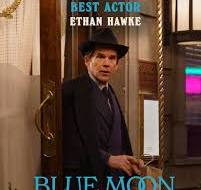
Director Richard Linklater cast long-time collaborator Ethan Hawke to play the main role and it is a superb performance.
Hawke captures the troubled, crumbling man Hart has become. He attends Sardi’s for the post-opening night production of Oklahoma! where he waxes between praise, sarcastic bon mots – which may or may not be understood by the targets – and his attempts to save face while confronting the fact he knows the musical is going to be a monstrous hit.
There is also another story, Hart’s fascination with Weiland (Margaret Qualley), a 20-year-old student of statuesque beauty. Hart is a 47-year-old, probably homosexual, with a comb over.
He tells anyone who will listen but mostly his favourite barman Eddie (Bobby Canavale) and GI piano player Morty Rivkin (Jonah Lees) of his infatuation. Also included is a Sardi’s customer, seated in the near empty restaurant before the post Oklahoma! party.
This turns out to be E.B. White (Patrick Kennedy) a prominent essayist for The New Yorker.
It is here Kaplow begins to have some fun. Hart tells White of a mouse he captures in his apartment every morning and that he puts the rodent back into the park only to have it return. He proffers that he has named him Stuart (“I don’t want him to be too pretentious”). The gag is that White eventually wrote Stuart Little (1945), the story of an intelligent mouse and famous in the children’s book canon.
When the crowd arrives, Elizabeth introduces Hart to a male student friend, George Hill. The young man wants to be a filmmaker. As Hart tries to separate him from his beloved, Hill is told “make films about friendships“. George Roy Hill directed Butch Cassidy & The Sundance Kid (1969) and The Sting (1973), two of the best “buddy” movies ever made.
Later Hammerstein, on his way to taking home a pre-high school child, seeks commendation for his own lyrics from Hart. The boy, Stevie, shows signs of having an encyclopaedic knowledge of theatre and musicals and isn’t over complimentary of Hart’s oeuvre.
In the credits he is listed as Stevie Sondheim (Cillian Sullivan). Stephen Sondheim later wrote Send in the Clowns and became a legendary composer and lyricist.
A lot is also made of Hart’s diminutive stature and Hawke plays him short. It is a neat cinematic trick by Linklater as the actor sits low on a bar stool; has a conversation with Rodgers on a staircase; sits soon after beginning another conversation with Rodgers; and looks dwarf like in the scenes with Elizabeth.
Neat trick as Google tells me Hawke is 1.79m. Scott and Qualley are both 1.73m.
However, it is Hart’s down staircase which we are watching.
During the night, he makes too much of an offer from Rodgers to write four or five new songs for a proposed rejuvenation of their 1927 musical A Connecticut Yankee (he did write them though).
Eddie serves him bourbon though Hart has previously given strict instructions that he is not to drink.
A tete-a-tete with Elizabeth where Hart wants all the details of a sexual encounter she had at her 20th birthday is intriguing. Does Hart just want titillation from her stories or is he really expecting to be her next lover?
When he introduces her to Rodgers and she leaves the party with him, it is clear her refusal of Hart’s love is even more damaging. She is using him to further her career.
The man’s demise is near complete. Eight months later Hart died in hospital after complications from pneumonia. He had been found drunk in an alleyway.
FOOTNOTES:
Rodgers and Hammerstein became one of the most successful songwriting duos in US music. Their musicals include: The Sound of Music, The King & I, South Pacific, Carousel and Oklahoma!.
Linklater directed Hawke and Julie Delpy in Before Sunrise (1995), Before Sunset (2004) and Before Midnight (2013) but are probably best known for Boyhood (2014).
Hawke has been nominated for a Best Actor Oscar in Blue Moon, after previously being a Best Supporting Actor nominee for Training Day (2002) and Boyhood. He was thrust into cinematic consciousness with his portrayal of one of Robin Williams’ students in Dead Poets Society (1989). He was the one who first jumped on his desk and shouted “Captain, my captain!”.
4.25
 I WRIGHT