Films about teachers doing extraordinary things with their students, or earning their respect and love, endure across the past century.
This subject would not have suited silent films but since the talkies in 1927, the most famous has probably been Goodbye Mr Chips (1939).
In turn, it’s fame lingers because Robert Donat, playing the titular role, won that year’s Best Actor Oscar against screen heartthrob Clark Gable at the height of his fame in Gone With The Wind.
Spencer Tracy followed the next year in Boys Town. Playing a priest, Tracy created a school-home where delinquent boys – Mickey Rooney in this case – could be raised with love and given some chance in the world.
There was Blackboard Jungle (Glenn Ford 1955), The Miracle Worker (Anne Bancroft 1962), To Sir With Love (Sidney Poitier 1967), The Prime of Miss Jean Brodie (Maggie Smith 1969), Stand and Deliver (Edward James Olmos 1988), Dead Poets Society (Robin Williams 1989), Mr Holland’s Opus (Richard Dreyfuss 1995) and The Holdovers (Paul Giamatti 2023) among many others.
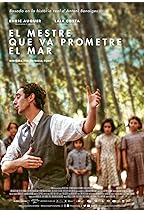
However, from memory, no teacher in these films suffered at the hands of the ruling regime quite like Antonio Benaiges (Enric Auquer) in The Teacher who Promised the Sea (2023). He paid with his life.
Benaiges is assigned a school near Briviesca, northern Spain in the mid 1930s. He brings progressive ideas, writes leftist-leaning articles in the local paper (the republic is in government) and wins over the children in his class. He falls foul of the local priest, himself the dismissed former teacher.
The teacher has brought an ancient printing press with him and shows the children, through creating their own books, the power of imagination and the written word. When he discovers they have never seen the sea, he asks them to create a book imagining what the ocean is like and promises to take them on a field trip to see it.
However, Spain is in transition mode. The fascists are gathering strength and the conservative village administration is prepared to go (as Louis Renault said in Casablanca (1942): “I blow with the winds and the prevailing wind is from Vichy”) with whatever regime is in command.
We see Benaiges’ effect on the children but when General Francisco Franco’s troops gain control in 1936, the teacher becomes the example the villagers are shown to cement the fascist’s ruthless power.
The story is told as present-day action when Ariadna (Laia Costa) searches for the body of her great grandfather. She takes a telephone call intended for her grandfather Carlos – now in a nursing home – who once requested information on his father.
A mass grave has been found near Briviesca and Ariadna cannot understand why her grandfather or mother have never talked of their heritage. The generations born in the first half of the 20th century didn’t talk of atrocities or war and their children were either too respectful to pursue it or thought it wiser to stay quiet.
Ariadna, battling her own problems (depression?) sets off in quest of an answer.
Through flashback we learn that Carlos was placed in the care of the teacher because his own father was in prison. Ariadna finds this among scant records in the public library where her great grandfather’s name – Bernardo Ramirez – is alongside that of Antonio Benaiges, who shared a cell with him after the coup.
Some of Benaiges’ students are still alive and the wonderfully warm Emilio (Ramon Agirre), who she meets when seeing the mass grave, proves a great help in fleshing out the story.
Indeed, warmth is the feel as we watch Benaiges teaching his young cohorts, who include Carlos, Emilio and Josefina, the mayor’s strong-willed daughter. The child actors are a delight and Augeur perfectly suited as the genial mentor.
Director Patricia Font and screenwriters Francesc Escobano and Albert Val lean heavily on the demonisation of the fascists and the villainy of the church in the latter part of the film. We are told of the bodies so far discovered in an era – the Spanish Civil War 1936-38 – which the Spanish apparently don’t feel comfortable discussing.
Font, a 15-year veteran as script supervisor in Spanish television and film, has directed three films with the other two very different to this message-strong movie. However, it rightly honours a man whose story needed to be told to his countrymen and the world alike.
Font’s other two films – In Family I Trust (2019) and Love, Divided (2024) – are comedies and well worth a look (SBS On Demand has both).
In the closing titles, the books created by Benaiges’ students and the class photograph taken outside the school are shown to still exist. A great testament to an achieving man.
4.5
 I WRIGHT