Allow me to suggest a hypothetical?
Writer-director Joel Coen married actress Frances McDormand in 1984, the year she appeared in the Coen Brothers’ debut feature, Blood Simple.
Writer-director Ethan Coen married film editor Tricia Cooke, three years after she worked as an apprentice editor on Miller’s Crossing (1990).
Since Blood Simple, the Coens have made some of the most recognisable films in our lifetime. A short list includes Raising Arizona (1987), Fargo (1996), The Big Lebowski (1998), Intolerable Cruelty (2003), No Country For Old Men (2007) and Burn After Reading (2008). There are more and any film creator would be happy to take ownership of most of them.
Since Blood Simple, McDormand has won three Best Actress Oscars for Fargo (1996), Three Billboards Outside Epping, Missouri (2017) and Nomadland (2020).
Since Miller’s Crossing, Cooke has worked in the editing department on Coen films; edited O Brother Where Art Thou (2000) with the Coens (they, curiously under the pseudonym Roderick Jaynes) and had two children, even though she is lesbian.
She and Coen are married, good friends and parents but each lives with another partner in two sections of the same house.
All the above is fact. The hypothetical is: did she and her husband agree to make Drive-Away Dolls (2024) to give her some cred after the fame the Coens and McDormand have achieved?
Harsh perhaps but this film is pretty lame when compared to the brothers’ output.
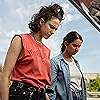
Drive-Away Dolls is a road movie set in 1999, involving two lesbian friends who take a drive-away* from Philadelphia, Pennsylvania to Tallahassee, Florida.
Confident but naughty Jamie (Margaret Qualley) is a free-spirited sexual athlete about to be kicked out of home for cheating on her police officer lover, Sukie (Beanie Feldstein).
Confident but strait-laced Marian (Geraldine Viswanathan) wants to leave her job and visit her Aunt Ellis in Florida.
Unbeknown to them, or the hire guy – a great cameo from Bill Camp as Curlie – the car contains a briefcase and a hat box with the severed head of a collector of unusual items.
Two goons Arliss (Joey Slotnick) and Flint (C J Wilson) are sent by their chief (Coleman Domingo) to retrieve the goods. Without SatNav and tracking devices their pursuit is thwarted and the two bicker madly during most of the chase.
Meanwhile, Jamie and Marian finally come to terms with what the viewer finds obvious. They are ideal for each other and fall in love.
When they discover their cargo, Jamie and Marian check into a high-end Tallahassee hotel. Jamie contacts Sukie who agrees to use her police knowledge to help only if Jamie takes back Alice B Toklas, her constantly yapping dog.
The chief tracks the women to the hotel, the goons arrive to apprehend them and then the plot twists. While the chief is relating why the briefcase’s contents matter to some very important people, Arliss and Flint argue about feelings and what appears to be the recriminations of a sexual encounter the two shared the night before.
“I was drunk,” says Flint, embarrassed by what the less-hetero Arliss has done to him. In anger he shoots him, panics, shoots the chief and runs.
Our heroines escape and Jamie formulates a plan to swindle the person who really wants the briefcase, Senator Garry Channel (Matt Damon). He is running for high office on a strict conservative/family man platform.
The women swap the briefcase and the hat box for a million dollars from Channel but he comes after them with a gun only to be thwarted by Sukie, who has come looking for Jamie to ditch the dog.
In a nod to Wild at Heart (1990), the hatbox flies into the air and the severed head lands nearby. It is one of several film references: Jamie’s reference to Se7en (1995) when Brad Pitt and Morgan Freeman are left a hat box and Freeman urges Pitt against opening it; Religious Aunt Ellis says: “Innovative” when Jamie tells her at the film’s end she is going to marry Marian. Shades of an in-love Joe E Lewis saying “Nobody’s perfect?” after the female-dressed Jack Lemmon reveals he is a man at the end of Some Like It Hot (1959). I am sure there were others.
The film had a lack of depth in many parts of what was a short 84 minutes.
Given there was extensive vision of a vicious greyhound pursuing the bunny in a dog race, this could have been intercut with Alice B Toklas taking similar action against one of the protagonists.
The summer of love (1969), which explained the contents of the briefcase** were created in this era. This was represented with the cutting in of psychedelic-style images familiar to viewers of late 60s-early 70s movies.
The visual images relied a lot on colourful, swirling lollipops plus a sort of James Bond-titles rip off of bodies in silhouette; and a sprinkling of the Monty Python contributor Terry Gilliam.
Often you want a film to be short but, even in the case of the low score, Drive-Away Dolls could have had a lot more flesh on its bones and been longer.
- More could have been made of Curlie
- We should have seen the circumstances and some of the intimacy involving the drunken and over-tired goons
- Jamie should have put up a room-dividing sheet a la Gable and Colbert in It Happened One Night (1934) so she could have sex with the woman she brought back to the motel from the gay bar
- Sukie and the dog were good and their roles could have been fleshed out more.
Instead we got steamy lesbian sex scenes to show Jamie’s high libido; a much-younger Marian drilling a hole in her fence to watch her curvaceous neighbour sun baking by her pool; college/high school girls swapping kissing partners in a basement of a suburban home; the goons turning up at a shack populated by African-Americans swinging to a jazz band, a scene that went nowhere.
This film could have been better.
_______________________________________________________________________________
* a vehicle which has to be transported from one city to another, allowing a free ride for the person(s) who agree to take it.
** The briefcase contains casts of the erect penises of prominent political and business people, made during the Summer of Love. The idea is based on the story of Cynthia Plaster Caster who used rock musicians, most famously Jimi Hendrix, as her models. (Miley Cyrus is Tiffany Plaster Caster in the film)
__________________________________________________________________________________
- The closing credits took the dolls out of the title and Drive-Away Dykes appeared. I sensed this was the title Coen and Cooke wanted but were over-ruled?
- Margaret Qualley was Pussycat, the Charles Manson follower picked up at the bus stop by Brad Pitt in Once Upon a Time in Hollywood (2019).
- Geraldine Viswanathan is an Australian comedienne who is in several films due for release.
- The Europeans (published 1878) by Henry James is used prominently. I read a synopsis of this book and could not get the allusion.
- It appears the original concept of Drive-Away Dolls was written by Coen and Cooke about 1999 (the era in which the film is set). In 2008, Cooke co-directed a short film, Don’t Mess With Texas (2008), which she co-wrote with Coen. There are similarities.
2
 I WRIGHT